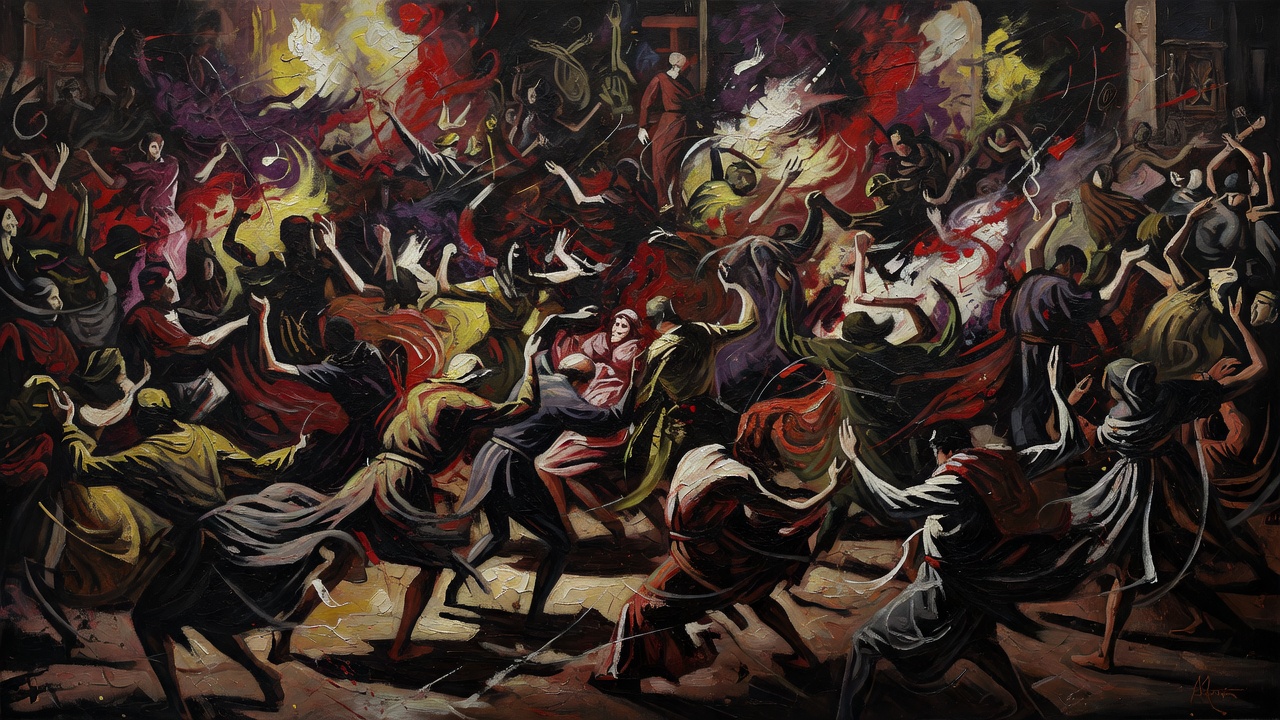
In July of 1518, a woman named Frau Troffea stepped into a narrow street in Strasbourg (then part of the Holy Roman Empire, now in France) and began to dance. There was no music playing, and her face bore no expression of joy. She simply moved erratically, continuing to dance until she collapsed from sheer exhaustion. After resting, she resumed her frenzied movements.
Within a week, more than thirty people had joined her. Within a month, the number had swelled to approximately 400 citizens. This was no festive gathering; it was a bizarre historical event that we now refer to as the Dancing Plague of 1518.
The Medical and Civic Response
As the frenzy spread, local authorities were thrown into a state of panic. Civic and religious leaders consulted local physicians who, following the medical doctrine of the time, ruled out astrological or supernatural causes. Instead, they diagnosed the affliction as a disease caused by "hot blood."
Their solution was highly counterintuitive by modern standards. The authorities reasoned that the only cure for the dancing was for the afflicted to dance it out of their systems. Consequently, they cleared the guildhalls and grain market to create massive dance floors. They even constructed wooden stages and hired professional musicians—pipers and drummers—to keep the afflicted moving, hoping to accelerate their recovery.
"The tragic irony of the dancing plague was that the authorities' well-intentioned intervention almost certainly prolonged the crisis by drawing a larger audience and encouraging the psychological contagion."
Predictably, this approach backfired. The continuous music and public spectacle only encouraged more citizens to join the frenzy. Contemporaneous chronicles state that at the height of the plague, many dancers succumbed to heart attacks, strokes, or sheer physical exhaustion.
Modern Theories: What Actually Happened?
Historians, sociologists, and medical professionals have debated the root cause of the Dancing Plague for centuries. Because we cannot clinically examine the victims, modern theories rely on analyzing the socio-economic conditions and contemporary records of the time. The main theories include:
- Ergot Poisoning: Ergot is a mold that grows on damp rye grain. Consuming ergot-tainted bread can cause ergotism, which leads to spasms, restricted blood flow, and hallucinations (the psychoactive chemical in ergot is closely related to LSD). However, critics of this theory argue that ergotism typically causes severe physical debilitation and loss of motor control, making it unlikely that victims could coordinate continuous dancing for days on end.
- Mass Psychogenic Illness (Mass Hysteria): This is currently the most widely accepted theory among historians. In 1518, Strasbourg was suffering from extreme poverty, rampant disease (including syphilis and the sweating sickness), and widespread starvation following a series of poor harvests. The immense psychological stress acting upon a deeply superstitious population may have triggered a mass psychogenic illness.
- Religious Fervor: The region held a deep-seated belief in St. Vitus, a Catholic saint who, according to local legend, had the power to curse sinners with a dancing plague. It is highly probable that the extreme anxiety of the populace manifested through the specific cultural lens of the St. Vitus curse.
Timeline of Events
| Date | Event |
|---|---|
| Mid-July 1518 | Frau Troffea begins dancing in the streets of Strasbourg. |
| Late July 1518 | Over 30 individuals join the uncontrollable dancing. Authorities consult physicians. |
| August 1518 | The crowd peaks at roughly 400 people. Musicians are hired; stages are built. |
| Early September 1518 | Authorities ban public dancing and music. Victims are taken to the shrine of St. Vitus. |
| Late September 1518 | The epidemic finally subsides as participants regain their faculties. |
The Aftermath
By early September, the city council recognized that encouraging the dancing was a severe misstep. They banned public music and dancing, instead opting to transport the afflicted via wagons to the shrine of St. Vitus in a nearby cave in Saverne. There, victims were given small crosses and red shoes sprinkled with holy water. Slowly, the epidemic subsided.
The Dancing Plague of 1518 remains one of the most vividly documented examples of mass psychogenic illness in human history. It serves as a stark reminder of how profound psychological trauma, combined with deep cultural superstitions, can manifest in shocking physical ways.